

Search and more...
Get Answers Fast With Our Learn More Page
Do you have trouble understanding your bill? Get answers to your questions and learn more with our Learn More page.
Search and more...
Do you have trouble understanding your bill? Get answers to your questions and learn more with our Learn More page.
We have officially transitioned to our new backflow management system to AquaResource.
Please be advised that we will no longer accept backflow test reports submitted via PDF, email, or paper copy. All test results must be entered and submitted directly through the AquaResource website.
- Register with AuqaResource Here
- Help on How to Register with AquaResource
- How to Submit Tests in AquaResource
- BRWC and LAWCO include local requirements and special cases, please consult the AquaResource Operations Guide for BRWC & LAWCO.
- If you are experiencing technical issues after reviewing the documentation, please call (225) 952-7617.
Thank you for your cooperation during this transition.
In accordance with Louisiana Department of Health (LDH) regulations, Baton Rouge Water Company, Parish Water Company, Ascension Water Company, and Ascension Consolidated Utilities District #2 manage a Backflow Prevention Program. This program protects the public water supply by preventing cross-contamination from backflow.

What is Backflow?
Backflow occurs when the normal direction of water flow in a pipeline or plumbing system is reversed, typically due to a change in water pressure caused by either backpressure or backsiphonage. Continue reading below for further details on the causes of these occurrences.
The pressure in the pipe connected to the water main is greater than the pressure in the main itself. This difference in pressure pushes water backward. This could be caused by pumps, piping systems elevation, or thermal expansion from a heat source.
Water can be pulled back into the water system due to loss of pressure in the system, such as a water main break, maintenance, or high-demand activities, including firefighting.
Backflow creates the potential for cross contamination, which is when water that has contacted chemicals or hazardous compounds is sucked back into our drinking water system.
Commercial: Commercial customers are required to have backflow prevention based on hazards defined in Louisiana Uniform Construction Code. See table 608.19.1 below for full list of commercial customers and associated hazards.
Industrial, Irrigation, and Fire Lines: Industrial, irrigation, and fire line services (per State Fire Marshal requirements) are required to have an approved backflow preventer installed and tested annually.
Auxiliary Water Supply or Dual Water Lines: Customers with an auxiliary water supply or dual water lines, such as a well or pond, also are required to install and maintain backflow prevention assemblies.
Table 608.19.1 – Containment Requirements | ||
|---|---|---|
Air Gap | ||
1. Fire Protection/Sprinkler System utilizing non-potable water as an alternative or primary source of water | ||
Reduced Pressure Principle Backflow Prevention Assembly | ||
1. Hospitals, Out-Patient Surgical Facilities, Renal Dialysis Facilities, Veterinary Clinics | ||
2. Funeral Homes, Mortuaries | ||
3. Car Wash Systems | ||
4. Sewage Facilities | ||
5. Chemical or Petroleum Processing Plants | ||
6. Animal/Poultry Feedlots or Brooding Facilities | ||
7. Meat Processing Plants | ||
8. Metal Plating Plants | ||
9. Food Processing Plants, Beverage Processing Plants | ||
10. Fire Protection/Sprinkler Systems using antifreeze in such system (a detector type assembly is required on unmetered fire lines) | ||
11. Irrigation/Lawn Sprinkler Systems with Fertilizer Injection | ||
12. Marinas/Docks | ||
13. Radiator Shops | ||
14. Commercial Pesticide/Herbicide Application | ||
15. Photo/X-ray/Film Processing Laboratories | ||
16. Multiple Commercial Units served by a master meter | ||
17. Any type of occupancy type or any other facility having one or more Single-walled Heat Exchangers which uses any chemical, additive, or corrosion inhibitor, etc., in the heating or cooling medium | ||
18. Any type of occupancy type or any other facility having one or more Double-walled Heat Exchangers which use any chemical, additive, or corrosion inhibitor, etc., in the heating or cooling medium and which does not have a path to atmosphere with a readily visible discharge | ||
19. Premises where access/entry is prohibited | ||
Pressure Vacuum Breaker Assembly/Spill Resistant
Vacuum Breaker Assembly
| ||
1. Irrigation/Lawn Sprinkler Systems | ||
Double Check Valve Assembly | ||
1. Fire Protection/Sprinkler Systems (a detector type double check valve assembly is required on unmetered fire lines) | ||
2. Two residential dwelling units served by a master meter, unless both units are located on a parcel or contiguous parcels of land having the same ownership and neither unit is used for commercial purposes. As used herein, the term “commercial purposes” means any use other than residential. | ||
3. Three or more residential dwelling units served by a master meter | ||
4. Multistoried Office/Commercial Buildings (over 3 floors) | ||
5. Jails, Prisons, and Other Places of Detention or Incarceration | ||
To prevent backflow and protect the quality of our drinking water, customers are required to fill water vessels safely and comply with backflow regulations. Below are some common ways of preventing backflow.
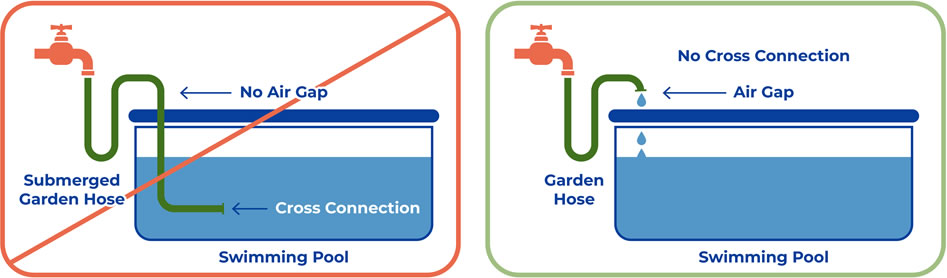
The most common form of cross connections on residential properties is a submerged hose in non-drinkable water. You can avoid this cross connection by filling the vessel (tub, swimming pool, ornamental fountain) with a gap between the end of the hose and the vessel, also known as an air gap.
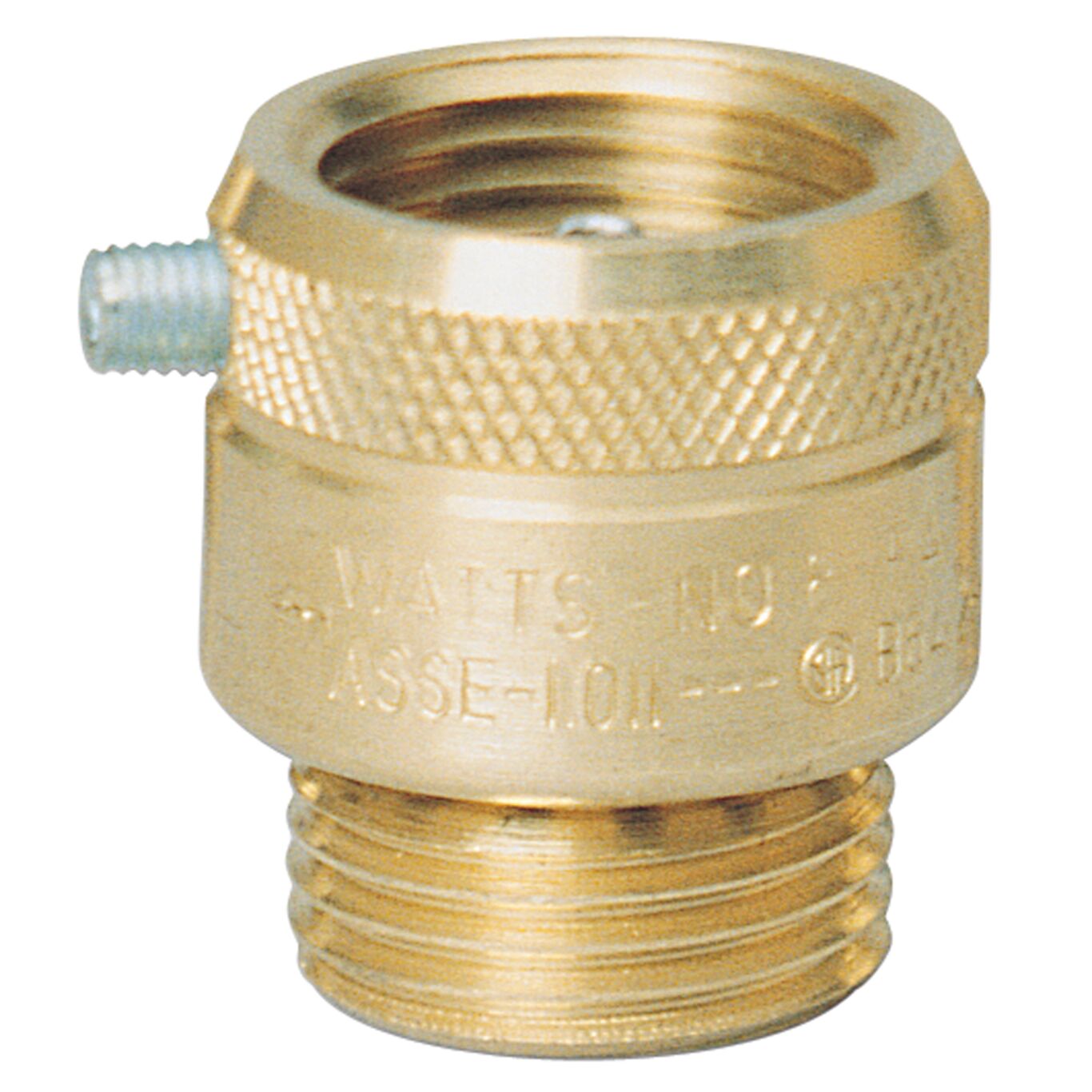
Another level of protection on your hose is a hose bib vacuum breaker; this device is not testable but is required to prevent cross connections between a hose and vessel for when an air gap is not achieved.
For irrigation systems, a Pressure Vacuum Breaker (PVB) is used to prevent backsiphonage of yard maintenance contaminants.

Not all cross connections can be eliminated, especially for commercial customers. In these cases, backflow preventers (BFPs) are installed within a customer’s plumbing system to prevent cross contamination.
The type of BFP will correspond with the degree of hazard as determined by the applicable codes. The customer shall install a Reduced Pressure Zone BFP to protect against the highest degree of hazard if the end use of the commercial service cannot be determined or if the end use of the commercial service could change. All BFP’s shall meet the requirements of all applicable federal, state, and local codes or ordinances for water service including, but not limited to, the Louisiana Department of Health (LDH), the International Plumbing Code (IPC), and the Louisiana Administrative Code (Titles 17 & 51).


Fire protection service connections are required to have an approved Double Check Detector BFP at the service connection to the public water supply or immediately downstream of the service connection.
Prior to initiating water service, the customer shall forward certification, signed by a licensed Louisiana Master Plumber with a Water Supply Protection Specialist (WSPS) endorsement, stating that the installation complies with all applicable codes. Click here for a list of approved installers.
Annual Testing and Reporting
Louisiana laws and regulations require customers with a backflow prevention device to have the system tested and inspected once a year. The inspection must be completed by a service provider certified to perform this type of work. For a list of certified plumbers, visit the LDH website. Once the test is complete, a copy of the inspection report must be submitted by email to backflow@batonrougewater.com. Customers who fail to submit a passed inspection within the past 12 months may have their water service turned off until a passed inspection is received.
The following procedures govern the installation and testing of backflow preventers (BFP) within the Baton Rouge Water Company (BRWC) service areas (including Parish Water Company and Ascension Water Company). It is the responsibility of each plumber to become familiar with the procedures established by BRWC. Failure to abide by the regulations set forth herein shall be cause for non-acceptance of installed and tested BFPs within BRWC.
To provide backflow testing and installation within our service area, plumbers must:
For details about these requirements, view our BRWC Backflow Prevention Program Policies and Procedures for Plumbers document.
Approved plumbers are required to follow the procedures outlined in the dropdown sections below.
Plumbers must contact and coordinate with BRWC prior to the installation or removal of any BFPs at 225-952-7617 or backflow@brwater.com. Additionally, upon completion of the installation, the plumber must contact BRWC for installation inspection and approval. For specific details about installation and retrofit policies and procedures, view our BRWC Backflow Prevention Program Policies and Procedures for Plumbers document.
Contact us at backflow@batonrougewater.com.
The Backflow Prevention Program is brought to you by:
